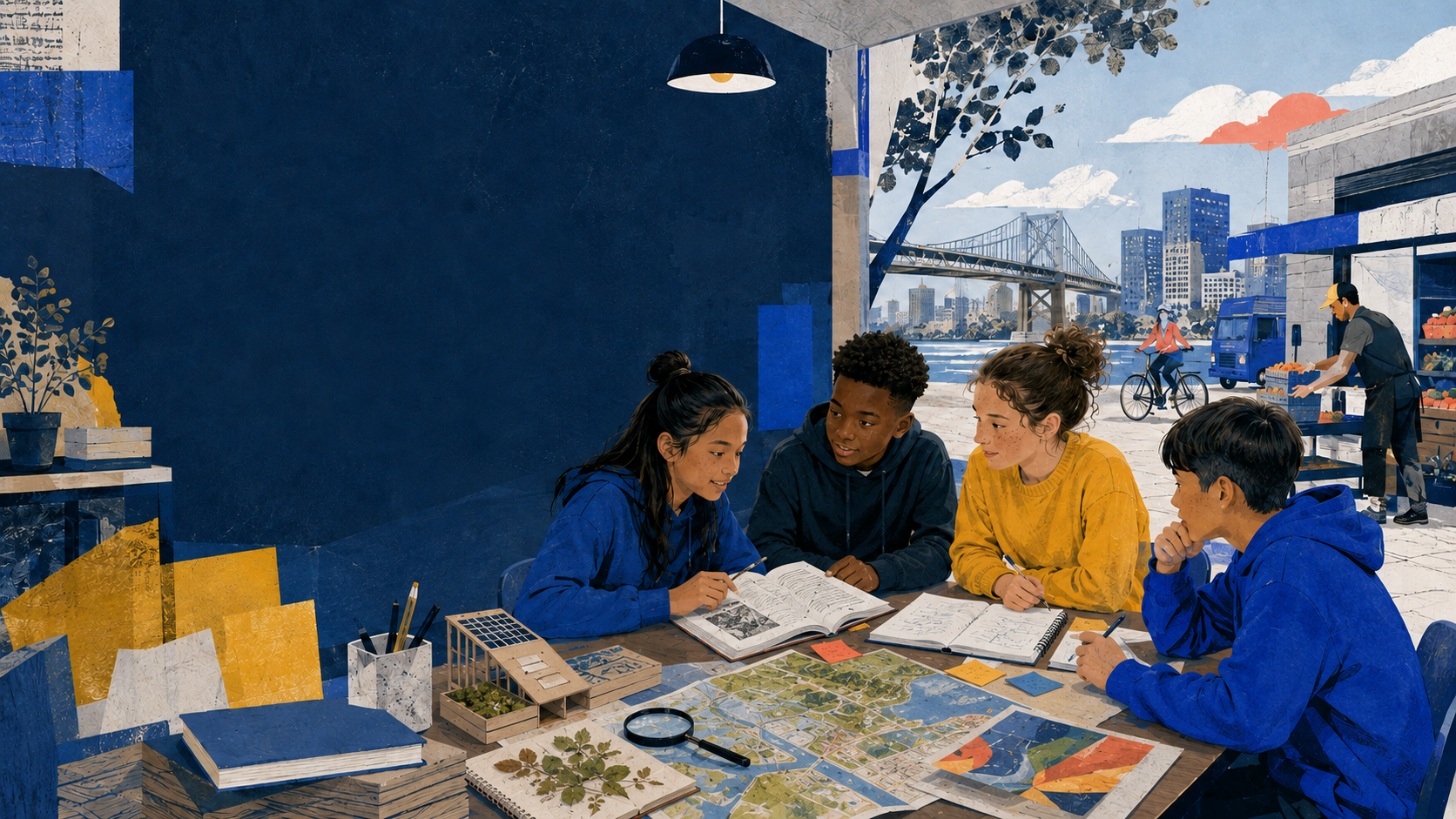
Learning as participation
rather than progression through content.
Learning should not feel separate from living.
The Lived Classroom helps teachers design learning across subjects in which students encounter ideas through the world, their bodies, materials, choices, and one another—then connect those experiences to explicit teaching, practice, and transfer.
For teachers who want more student thinking without giving up clarity, structure, or rigor.
The central idea
Not less teaching.
A better reason to learn.
Learning is not the passive receipt of information followed by a performance that allows everyone to say the content was learned. It becomes a living practice when students invest in the intellectual work, recognize the value and power of knowledge, and take ownership of their thinking. As one part of that process, teachers ensure that students have opportunities to take what they have learned outward and determine where it holds relevance: in their own lives, within the classroom or school community, or beyond.
This does not mean every lesson must become a project, every application must reach a public audience, or students must be left to discover everything alone. Teachers still teach clearly, model, guide, and provide practice. They also cultivate willing intellectual participation by inviting students to author relevance within purposeful guardrails, so students leave not only knowing more, but with a stronger sense of what knowledge enables them to understand, contribute, and influence.
The Lived Classroom cycle
From encounter to understanding
The cycle is a design lens, not a script. A full experience may unfold in one lesson or thread through a unit.
- 01
Encounter
Meet a situation, object, question, puzzle, text, or decision that creates a genuine need for new knowledge, a concept, or a skill.
- 02
Predict
Commit to an initial idea. Estimate, anticipate, or choose before the method is supplied.
- 03
Investigate
Manipulate, model, test, move, sort, calculate, or discuss within purposeful boundaries.
- 04
Notice & Compare
Make patterns and differences visible. Listen across strategies and revise thinking.
- 05
Name & Model
The teacher formalizes the learning, models disciplinary tools and methods, and connects experience to precise language, representations, and vocabulary.
- 06
Practice
Build accuracy and fluency through focused, supported, and independent work.
- 07
Transfer
Apply the idea in a new form, context, or decision—and identify what now makes sense.
Students encounter learning as something to investigate, discuss, use, and make decisions with—not merely content to receive and repeat.
What this looks like day to day
Experiences become anchors and bridges.
The aim is not a project every day. It is a curriculum students can enter, remember, and use.
Create a shared encounter
A compact experience gives the class something concrete to reason from and return to.
Connect experience to formality
The teacher calls back to what students noticed while introducing vocabulary, representations, and procedures.
Make fluency purposeful
Quiet individual practice still matters. Students now know what the method describes and when it is useful.
Test for transfer
A new context reveals whether understanding can travel beyond the original activity.
Agency within structure
Students lead their intellectual work. Teachers steward the conditions.
Agency may be as small as choosing numbers, defending a strategy, changing a prediction, inventing a relevant context, or deciding what evidence is convincing. It grows through structure, regulation, voice, and responsibility—not through the absence of guidance.
The framework in practice
Classroom experiences
These early examples come from mathematics, but the framework is not tied to one subject or grade. Its design principles can shape a lesson, a resource, or the rhythm of an entire unit.
Operations01
Number of Me
Students build numerical expressions from details about themselves, then use the order of operations to reveal how sequence changes a result.
- Identity without oversharing
- Classroom routines in motion
- Expressions and order of operations
Ratios02
Color Lab
Students mix, compare, and name colors to experience equivalent ratios before connecting parts, wholes, fractions, and percentages.
- Concrete ratio reasoning
- Student-created formulas
- Equivalent relationships
Geometry03
2D to 3D Net Lab
Students predict, fold, test, and revise nets before formalizing surface area and the relationship between two- and three-dimensional forms.
- Spatial reasoning
- Prediction and revision
- Nets and surface area
Coordinates04
Our Class Plotted
Students turn the classroom into a coordinate plane, using desks as points and movement to locate ordered pairs across positive and negative quadrants.
- Whole-class movement
- Coordinate-plane reasoning
- Positive and negative values
Why this matters now
When answers are abundant, classrooms must protect the work of becoming a thinker.
Students need more than access to information. They need reasons to wonder, chances to test ideas, language for explaining what they see, and other people with whom to make meaning.
The Lived Classroom keeps the human work of learning at the center: attention, judgment, persistence, imagination, belonging, and the responsible use of one’s own mind.
About The Lived Classroom
Built where child development, classroom reality, and curriculum meet.
The Lived Classroom was created by Jillian Waring, an occupational therapist and educator, from a question that would not go away: How can learning be something students actively participate in without exhausting teachers, overwhelming students, or sacrificing clear instruction?
The work begins with a belief that applies across ages and subjects: rigor and aliveness belong in the same room.